

Swiss mortgage interest rate forecast
Our assessment of the mortgage market
How will mortgage interest rates develop over the coming months? Find out how our experts view developments on the mortgage and real estate markets.
Data valid as of: 24.09.2026
Copy deadline: 24.09.2026
- The Swiss National Bank (SNB) is leaving the policy rate at zero percent for the time being, but is likely to move away from the zero interest rate mark in the medium term.
- This means both Saron and fixed-rate mortgages are likely to gradually increase slightly over the coming months, but both remain attractive.
- Saron mortgages are expected to stay the somewhat cheaper option.
Current economic situation at a glance
The Swiss economy has recovered steadily over the course of the year and returned to significant growth in the second quarter. At a rate of almost 2 percent compared to the previous quarter, it has risen as sharply as in any other full year. This is the strongest growth surge since the recovery from the coronavirus pandemic five years ago. It is positive that, although this strength was mainly driven by the pharmaceutical industry, all other sectors also made gains, which points to a broad-based recovery. It is also encouraging that recent meagre investments are picking up again. This is partly because companies are once again looking to the future with greater optimism, and suggests that the positive trends will continue in the second half of the year.
Our interest rate forecast at a glance
| Forecast for | 3 months | 6 months | 12 months |
|---|---|---|---|
| Forecast for Saron |
3 months |
6 months |
12 months |
| Forecast for 5-year fixed-rate mortgae |
3 months |
6 months |
12 months |
| Forecast for 7-year fixed-rate mortgage |
3 months |
6 months |
12 months |
| Forecast for 10-year fixed-rate mortgage |
3 months |
6 months |
12 months |
Pressure on the SNB to act is likely to remain moderate for the time being, as there is no sign of a significant rise in inflation. However, with economic growth picking up again, a weaker Swiss franc and international central banks already noticeably hiking interest rates, the current environment offers the SNB a window of opportunity to normalize monetary policy and return to positive policy rates in the medium term. We expect it to make use of this opportunity cautiously. In this context and in light of global pressure for higher capital market interest rates, fixed-rate mortgage interest rates are also anticipated to rise slightly.
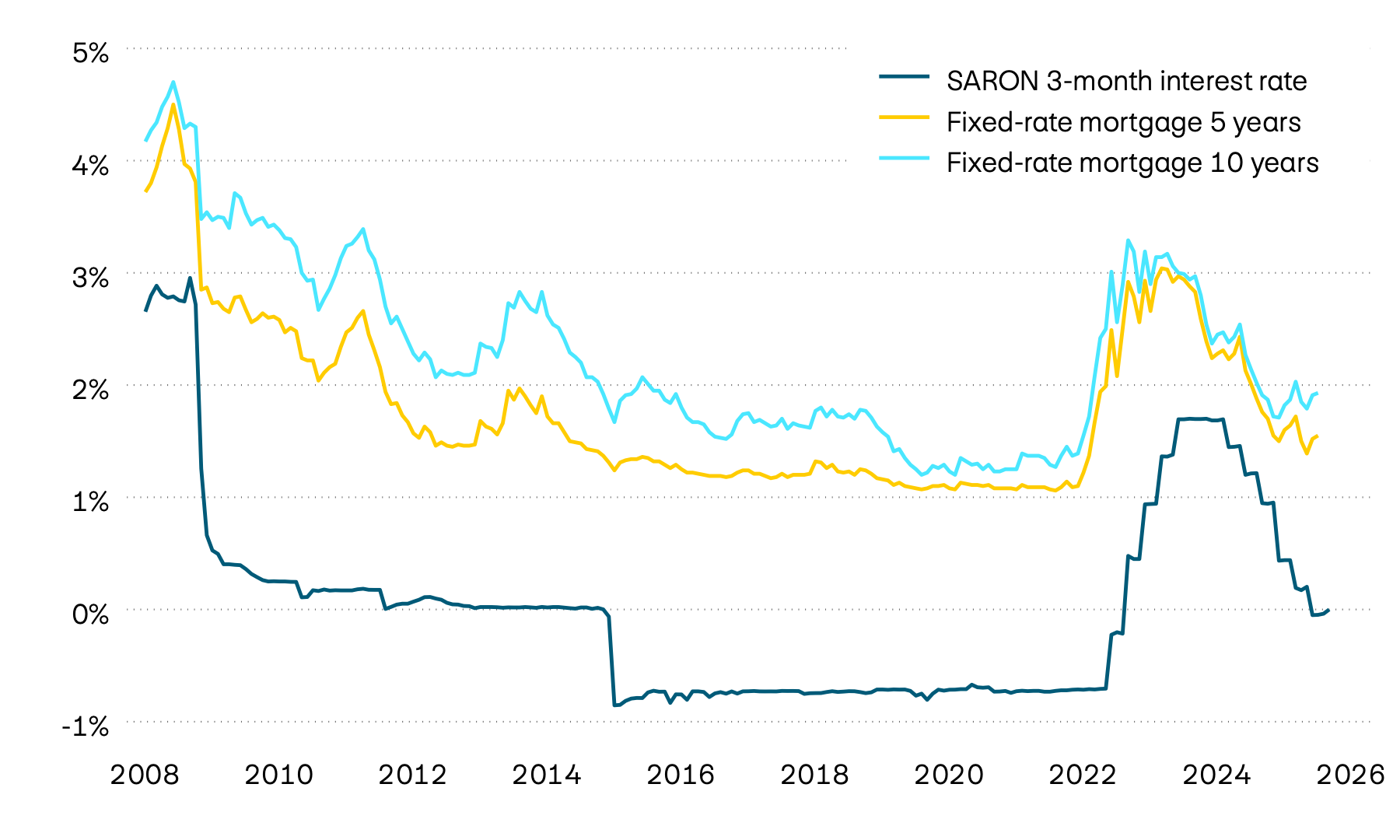
Mortgage rates in Switzerland have fallen significantly since their highs in 2023. The Saron’s decline was particularly sharp. After the SNB’s policy rate cuts, the 3-month Saron is now close to zero percent again. Fixed-rate mortgages also became much cheaper. However, they have become considerably more expensive again since this summer. This is due to higher capital market interest rates in Switzerland as well. In the coming months, the Saron is forecast to remain largely stable initially, while we expect interest rates on fixed-rate mortgages to rise slightly. The SNB is likely to leave the policy rate at zero percent in its next assessment on 10 December 2026. In March 2027, however, we anticipate an initial increase to 0.25 percent and a second step up to 0.5 percent later in the year. This means that the Saron is likely to rise again over the course of the coming year.
In percent
Single-family homes and condominiums
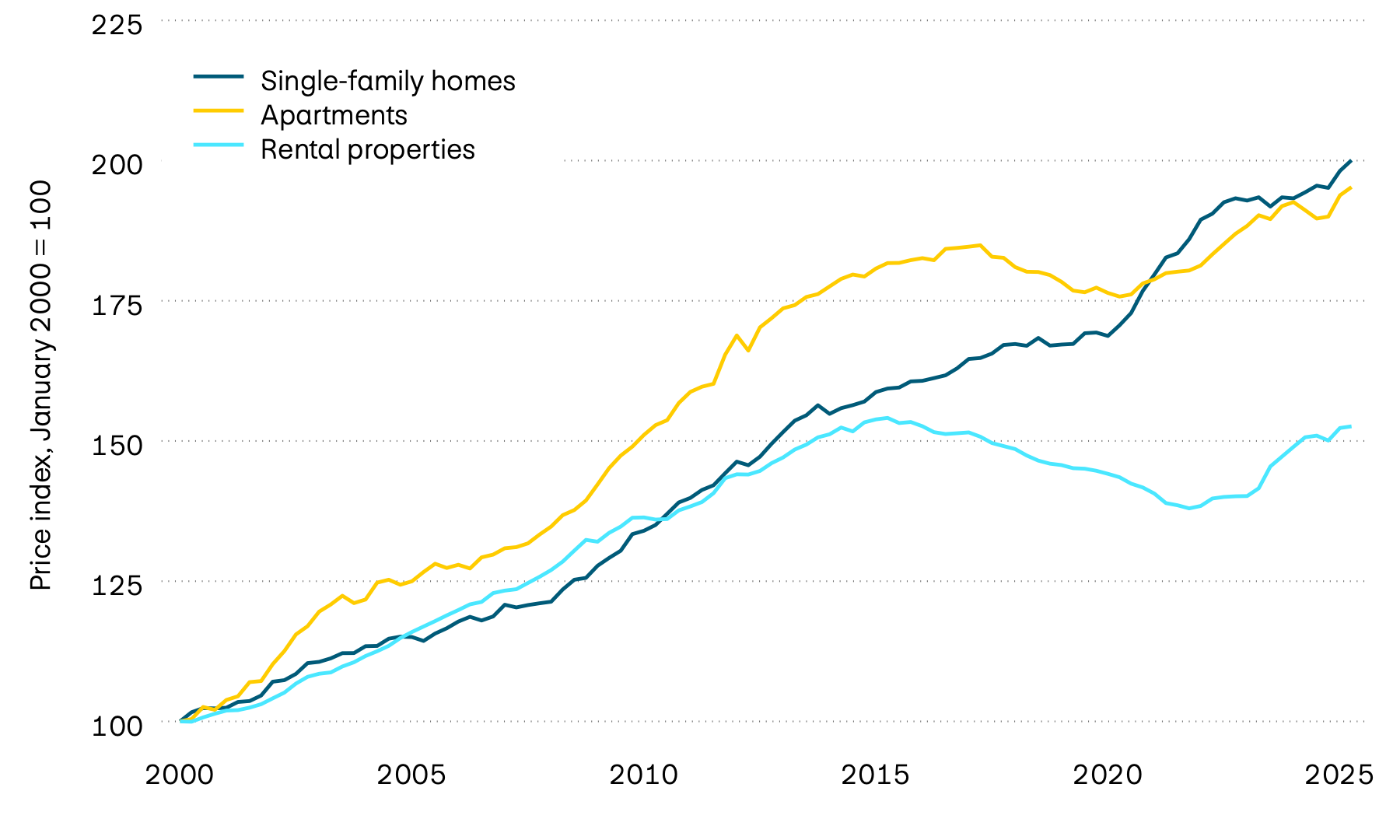
Prices on the Swiss real estate market have largely risen recently. Both single-family homes and owner-occupied apartments increased in price compared to the previous quarter. The price trend for owner-occupied apartments strengthened once again, while the prices of single-family homes also rose again after the weaker performance at the start of the year. It means the owner-occupied property market is robust, despite the recent growth in interest rates for fixed-rate mortgages. This is due to the fact that overall financing costs remain low, particularly for money market mortgages. At the same time, supply remains scarce, as it is still the case that only a small amount of new housing is being built. The price trend for rental apartments has also picked up again. The dampening effects of the earlier reference interest rate cuts are now likely to have largely dissipated, while the scarce housing supply continues to put upward pressure on rents.
Price index, January 2000 = 100
Interested in real estate as an investment opportunity? In our Investment compass under “Market overview”, you will find an analysis of the current situation on the Swiss real estate market.
What our experts say
“The owner-occupied property market is robust despite the recent growth in interest rates for fixed-rate mortgages. This is due to the fact that overall financing costs remain low.“
Receive our assessment directly by e-mail after each SNB decision.

Fixed-rate mortgage or Saron mortgage?
-
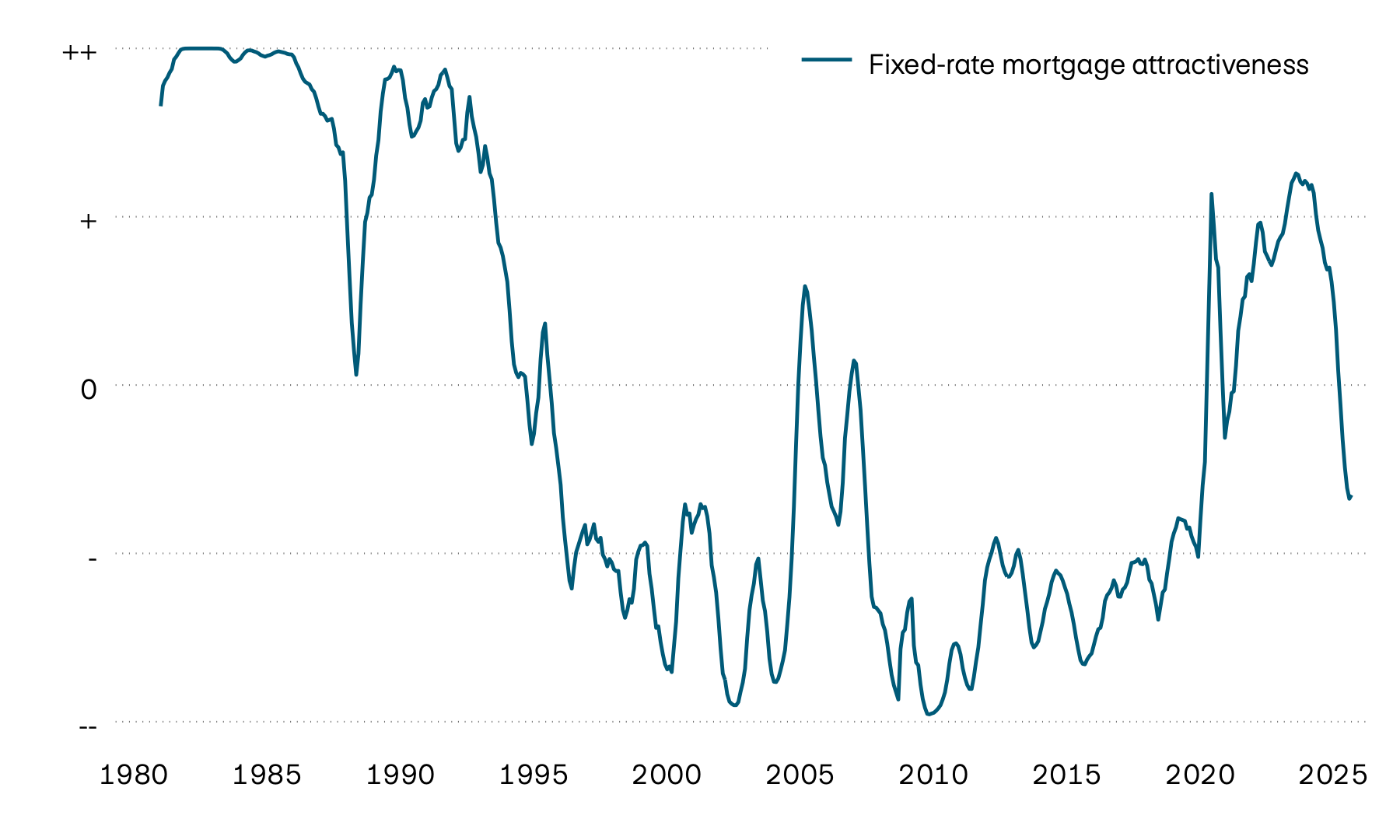
Attractiveness of fixed-rate mortgages 1980–2026. Source: PostFinance Ltd, SNB, SIX, Web Financial Group, SECO, KOF Attractiveness of fixed-rate mortgages 1980–2026. Source: PostFinance Ltd, SNB, SIX, Web Financial Group, SECO, KOF -

The interest rate of the fixed-rate mortgage remains fixed across the selected term. The interest rate of the fixed-rate mortgage remains fixed across the selected term. -

The interest rate is based on the current market situation. The interest rate is based on the current market situation.
Which is the right mortgage for me?

Gain an overview of the conditions for the fixed-rate mortgage and the Saron mortgage with our mortgage comparison.
| Indicators | Q4 2025 | Q1 2026 | Q2 2026 | 2024 | 2025 | 2026 |
|---|---|---|---|---|---|---|
| Indicators GDP growth |
Q4 2025 1,2% |
Q1 2026 0,5% |
Q2 2026 2,8% |
2024 1,3% |
2025 1,0% |
2026 1,0% |
| Indicators Inflation |
Q4 2025 0,1% |
Q1 2026 0,2% |
Q2 2026 0,6% |
2024 1,1% |
2025 0,2% |
2026 0,6% |
| Indicators Unemployment |
Q4 2025 3,0% |
Q1 2026 3,2% |
Q2 2026 3,0% |
2024 2,5% |
2025 2,8% |
2026 3,2% |
| Indicators Net immigration |
Q4 2025 27‘000 |
Q1 2026 21‘000 |
Q2 2026 14‘000 |
2024 83‘000 |
2025 75‘000 |
2026 70‘000 |
| Indicators EUR/CHF exchange rate |
Q4 2025 0,93 |
Q1 2026 0,91 |
Q2 2026 0,92 |
2024 0,95 |
2025 0,94 |
2026 0,92 |
Source: Bloomberg, Communify Ltd, BfS
-
Forecasting is a well-founded assessment, not a certainty. Whether now is the right time for you very much depends on your personal risk appetite, your financial situation and your individual needs.
If interest rates are falling: if you expect interest rates to continue to fall, a Saron mortgage may be an attractive option to benefit from the cuts, depending on the interest rate level.
If interest rates are rising: if you are expecting an interest rate rise or budget security is very important for you, it may be a good idea to fix the conditions over the long term with a fixed-rate mortgage.
Our specialists will be happy to help you find the right strategy.
-
The SNB policy rate can affect mortgage interest rates. This usually happens quickly with variable models such as the Saron mortgage, as these are based directly on short-term money market rates. Fixed-rate mortgages, however, are driven more by long-term capital market interest rates (swap rates) which to some extent already take into account anticipated future monetary policy and inflation. If a policy rate change is expected by the markets, its effect on fixed-rate mortgages could in many cases already be reflected in the interest rates beforehand.
-
Choosing the term is a strategic decision. Long terms (7–10 years or more) provide you with interest rate security over a long period of time, but are often slightly more expensive. Shorter terms (2–5 years) are usually cheaper, but require you to address the interest rate situation again sooner. Splitting is a popular strategy: you can split your mortgage into several tranches with different terms if required. This spreads the interest rate risk and avoids having to renew the total amount at once at potentially unfavourable conditions.
-
The cost advantage of Saron mortgages may narrow slightly, but it will remain for the time being.
-
The right mortgage for you depends greatly on your personal risk appetite, your financial situation and your individual needs. Our specialists will be happy to help you find the right strategy for you.
-
Our interest rate forecasts are produced by our economists on the basis of in-depth analyses of the global and national economic situation, inflation trends and the monetary policy of central banks. They represent a likely development. However, ongoing or unforeseen economic or political events can have an impact on interest rate developments at any time. Forecasts should therefore always be seen as a guide and not a guarantee.
-
Prices are mainly influenced by supply and demand. Low mortgage interest rates can generally boost demand for home ownership, as financing costs fall. This can lead to stable or rising real estate prices. Conversely, if interest rates rise sharply, this can dampen demand – but it doesn’t have to, especially if supply remains tight. Political decisions on mortgage lending can also influence demand for residential property and therefore property prices.
-
Yes, that is possible. With a forward mortgage, you can secure the current interest rates today – even if your existing mortgage is not set to expire for several months (e.g. in six, 12 or up to 18 months). Depending on the lead time, requested term and market situation, an interest rate premium (forward premium) may be incurred. In return you will be protected against any interest rate rises until your current mortgage expires. Please contact us for a non-binding quotation.
This document and the information and statements it contains are for information purposes only and do not constitute either an invitation to tender, a solicitation, an offer or a recommendation to buy the related products. The customer or third parties are responsible for their own actions and bear sole responsibility for compliance with legal and regulatory provisions and guidelines. PostFinance has used sources considered reliable and credible. However, PostFinance cannot guarantee that this information is correct, accurate, reliable, up to date or complete and excludes any liability to the extent permitted by law. Information on interest rates and prices is up to date, but the actual development may deviate from these forecasts at any time. The content of this document is based on various assumptions. This means that the information and opinions are not a fixed basis for your financing decision. We recommend consulting an expert before making decisions.
Full or partial reproduction is not permitted without the prior written consent of PostFinance.
Interest rate forecast for download
-
Interest rate forecast for PostFinance mortgages, september 2026 (PDF) The link will open in a new window
-
Interest rate forecast for PostFinance mortgages, june 2026 (PDF) The link will open in a new window
-
Interest rate forecast for PostFinance mortgages, march 2026 (PDF) The link will open in a new window
-
Interest rate forecast for PostFinance mortgages, december 2025 (PDF) The link will open in a new window


